
Fabrication without the drawing
Yard steel that 'looks strong' is not a grillage. We fabricate against the load case.
Grillage & Equipment Fabrication
Grillages and equipment fabricated to our engineering — sea-fastening structures and temporary works included — so what is built is what was calculated.
The Problem
Yard steel that 'looks strong' is not a grillage. We fabricate against the load case.
Temporary steel still carries the cargo. It is designed, then built, then used once with the same care.
Welded in a rush beside the ship is not a structure. We prefabricate to the plan.
If it is not checked to the drawing, it is not our equipment. Partners execute; we own the specification.
The Solution
How Grillage & Equipment Fabrication works
Load-spreading frames fabricated to the geometry, welds, and bearing in the design.
Stoppers and fastening steel built before the cargo arrives, not during the stow.
Supports and modifications for a single move — still engineered, still inspected.
Lift beams, stools, and project steel delivered to the same specification as the study.
How we work
Heavylift fails when the cargo is treated as a booking. We start with stress points, stability curves, and a packing design that can survive open water — then we execute against that blueprint.
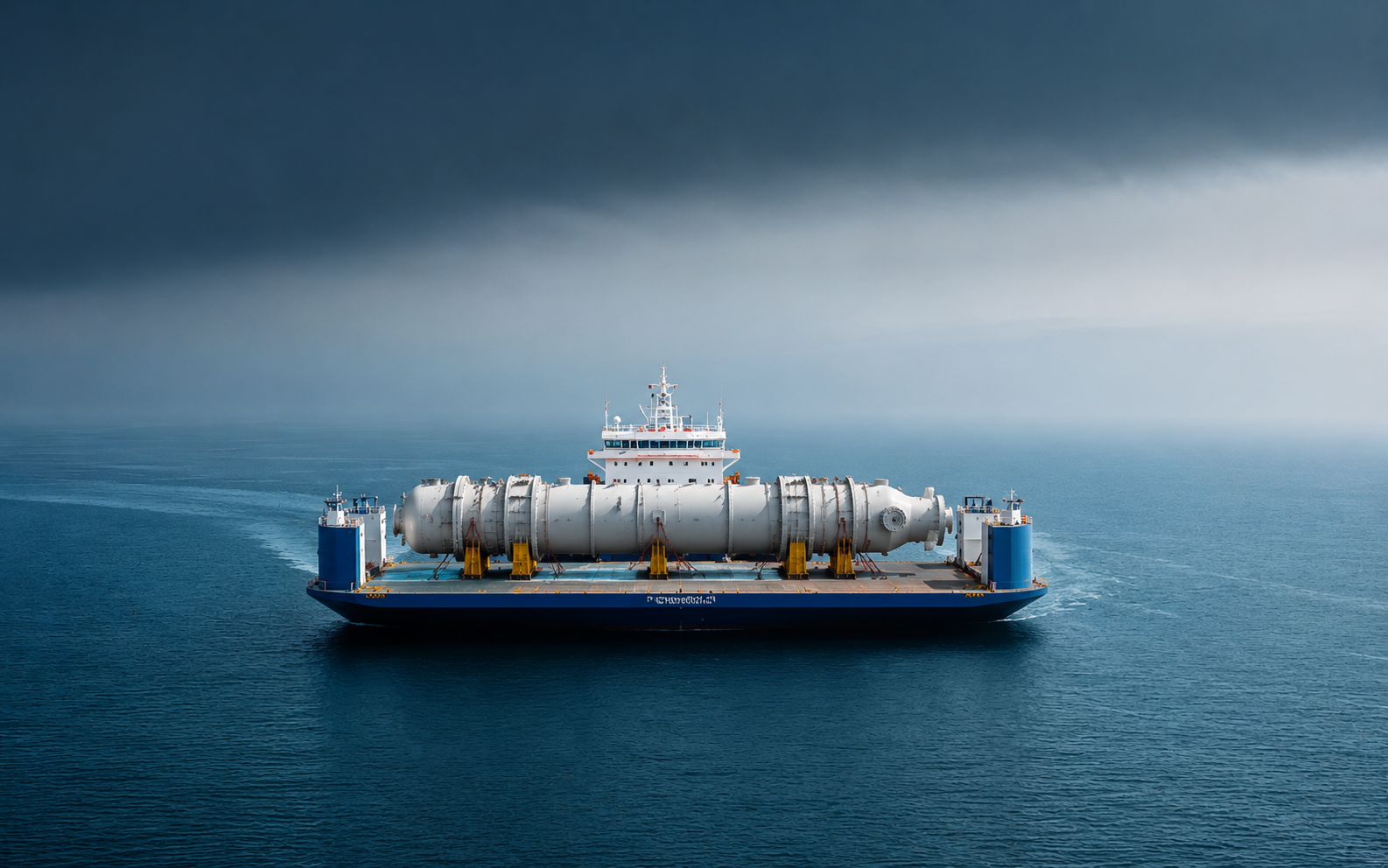
“Where others see tonnage, we see a blueprint. The move is designed before a crate is lifted.”
OOG
Out-of-gauge cargo engineered, not forced into a box
4
Disciplines under one standard of precision
Disciplines
Before a single crate is lifted, our marine engineers calculate stress points, stability curves, and load paths. It's the invisible math that keeps a 200-tonne transformer sitting still in open water.
OOG
Out-of-gauge cargo
ODC
Over-dimensional loads
Tell us about the cargo, the route, and the constraints. We start with engineering, not a booking note.
Trusted across the GCC for OOG and ODC cargo movement.