
Tonnage treated as a booking
A sailing slot is not a load path. Without marine calculation, heavy cargo is hoped into place rather than engineered into it.
Marine Engineering
Before a single crate is lifted, our marine engineers calculate stress points, stability curves, and load paths. It's the invisible math that keeps a 200-tonne transformer sitting still in open water.
The Problem
A sailing slot is not a load path. Without marine calculation, heavy cargo is hoped into place rather than engineered into it.
Open-water behavior cannot be improvised at the hook. Stability curves and seafastening belong in the study, not the incident report.
If stress points are not calculated against the actual object, the ship, and the sea state, the move is a guess with a crane.
Forwarders coordinate. We calculate. Marine engineering is the authority that the rest of the chain executes against.
The Solution
How Marine Engineering works
Curves, accelerations, and lashing designed for the voyage — so a 200-tonne transformer sits still in open water.
We map how force travels through cargo, cradle, deck, and hull before anyone signals the crane.
Sea state, routing, and vessel motions are inputs to the engineering, not surprises after departure.
Marine numbers drive packing design and vessel modification. Four disciplines, one model.
How we work
Heavylift fails when the cargo is treated as a booking. We start with stress points, stability curves, and a packing design that can survive open water — then we execute against that blueprint.
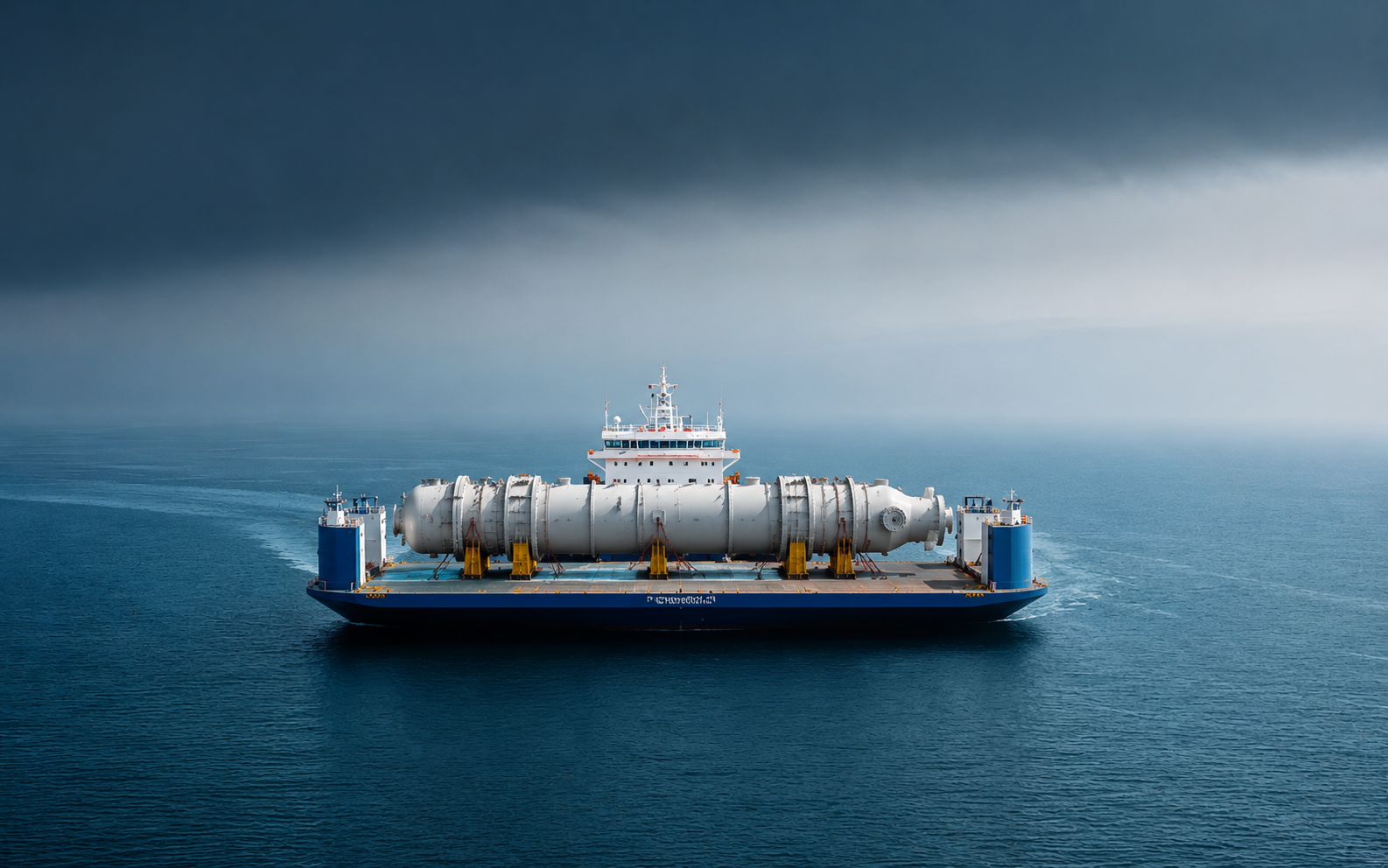
“Where others see tonnage, we see a blueprint. The move is designed before a crate is lifted.”
OOG
Out-of-gauge cargo engineered, not forced into a box
4
Disciplines under one standard of precision
Disciplines
Before a single crate is lifted, our marine engineers calculate stress points, stability curves, and load paths. It's the invisible math that keeps a 200-tonne transformer sitting still in open water.
OOG
Out-of-gauge cargo
ODC
Over-dimensional loads
Tell us about the cargo, the route, and the constraints. We start with engineering, not a booking note.
Trusted across the GCC for OOG and ODC cargo movement.