
Mooring treated as a weather call
If line loads, heading, and station-keeping are not in the study, the lift window is a guess.
Services
We analyse vessel moorings and plan offshore lifts for jacket and topside installations, from rigging design and vessel positioning to the final installation sequence.
Request a feasibility studyThe Problem
If line loads, heading, and station-keeping are not in the study, the lift window is a guess.
Jacket and topside lifts need a rigging design before the vessel is on location — not after the boom is up.
Vessel position, crane outreach, and set-down geometry are one move. Separate plans fail at the interface.
The order of lift, stab, and weld-out belongs on paper with the mooring and the weather window.
The Solution
How Offshore Engineering works
Line, heading, and station-keeping analysed so the vessel can hold the lift, not just the weather.
Jacket and topside lifts planned as a calculated operation — mass, CG, and crane capacity included.
Slings, spreaders, and lift points specified before the vessel is on location.
Positioning, set-down, and the order of work as one brief from the first lift to final installation.
How we work
Heavylift fails when the cargo is treated as a booking. We start with stress points, stability curves, and a packing design that can survive open water — then we execute against that blueprint.
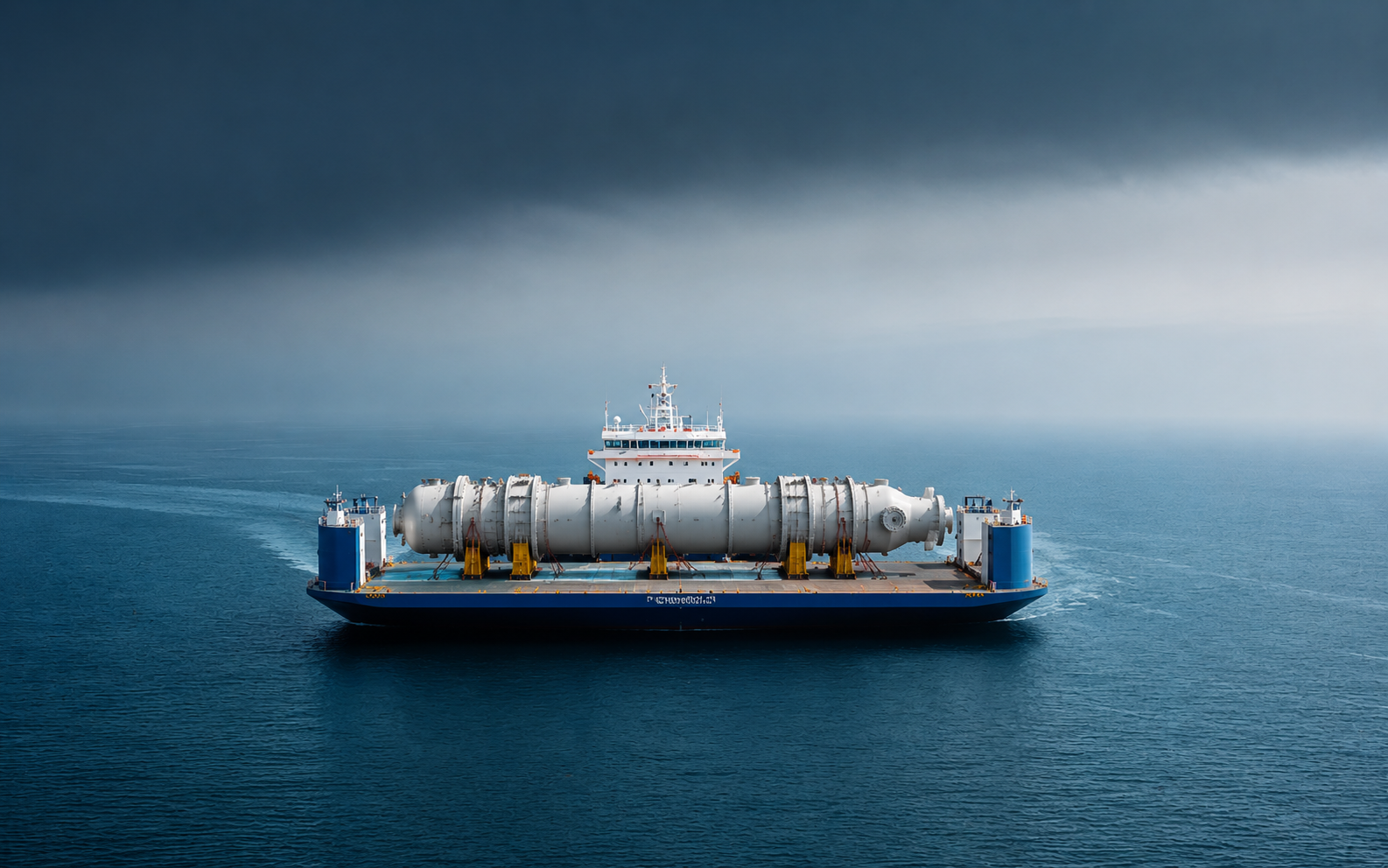
“Where others see tonnage, we see a blueprint. The move is designed before a crate is lifted.”
OOG
Out-of-gauge cargo engineered, not forced into a box
4
Disciplines under one standard of precision
Disciplines
Before a single crate is lifted, our marine engineers calculate stress points, stability curves, and load paths. It's the invisible math that keeps a 200-tonne transformer sitting still in open water.
OOG
Out-of-gauge cargo
ODC
Over-dimensional loads
Tell us about the cargo, the route, and the constraints. We start with engineering, not a booking note.
Trusted across the GCC for OOG and ODC cargo movement.