
Strength assumed from a nameplate
A transformer that can sit in a substation may not survive a lift or a sea state. We check the cases that travel.
Structural Engineering & Design
Structural engineering and design for how force travels through the object, the support, and the conveyance. The load path is the move.
The Problem
A transformer that can sit in a substation may not survive a lift or a sea state. We check the cases that travel.
Cradle, deck, and foundation must agree. Structure that stops at the cargo outline will fail at the bolt.
If we cannot show how force leaves the hook and enters the hull, we do not lift.
FEA and strength checks belong before steel is cut — not as a rescue after a crack.
The Solution
How Structural Engineering & Design works
Supports, frames, and local reinforcement drawn for handling, voyage, and erection.
Static, dynamic, and fatigue cases that match how the cargo will actually move.
How the object meets grillage, trailer, barge, and foundation — as one set of drawings.
Force mapped from lift point to bearing so nothing is asked to carry what it cannot.
How we work
Heavylift fails when the cargo is treated as a booking. We start with stress points, stability curves, and a packing design that can survive open water — then we execute against that blueprint.
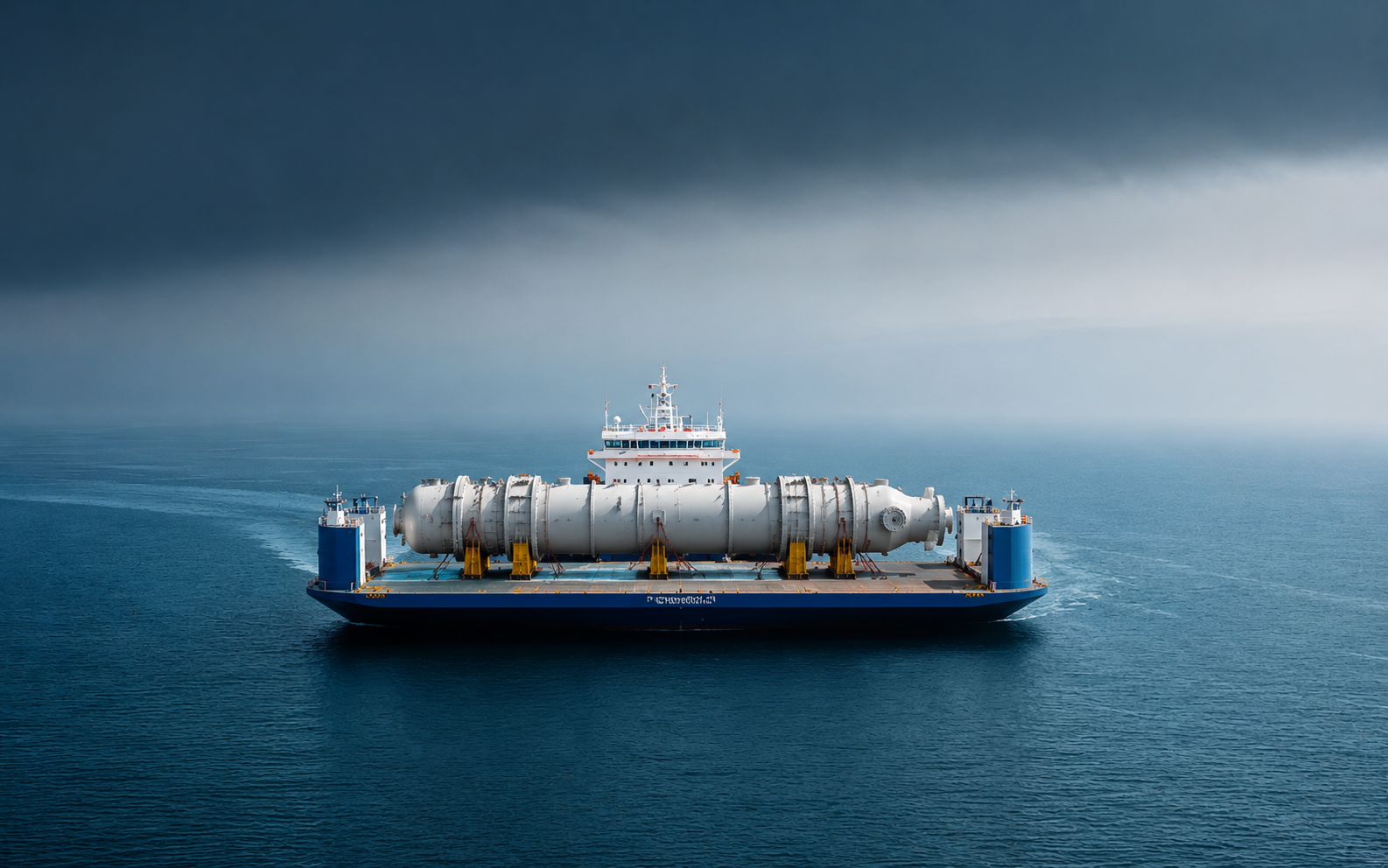
“Where others see tonnage, we see a blueprint. The move is designed before a crate is lifted.”
OOG
Out-of-gauge cargo engineered, not forced into a box
4
Disciplines under one standard of precision
Disciplines
Before a single crate is lifted, our marine engineers calculate stress points, stability curves, and load paths. It's the invisible math that keeps a 200-tonne transformer sitting still in open water.
OOG
Out-of-gauge cargo
ODC
Over-dimensional loads
Tell us about the cargo, the route, and the constraints. We start with engineering, not a booking note.
Trusted across the GCC for OOG and ODC cargo movement.