
Quay treated as a parking slot
If ground bearing, barge ballast, and linkspan are not in the study, load-out is a hope with a trailer.
Load-out & Load-in
Load-out and load-in engineering so the cargo meets the quay, barge, and site as one plan — Ro-Ro, skid, or lift, designed before the tide window.
The Problem
If ground bearing, barge ballast, and linkspan are not in the study, load-out is a hope with a trailer.
The receiving quay is still part of the move. We engineer both ends, not only the departure.
Ramp angle, draft, and cargo CG have to agree. Otherwise the operation stops on the hinge.
Windows close. Ballast, fenders, and skid paths belong on paper before the cargo rolls.
The Solution
How Load-out & Load-in works
Trailers, skids, cranes, and barge interface specified against the cargo and the berth.
The receiving end is designed with the same authority as the departure.
Ground, fender, ballast, and set-down as one plan — not three contractors.
Ramp, draft, and roll path calculated so the cargo can move under control.
How we work
Heavylift fails when the cargo is treated as a booking. We start with stress points, stability curves, and a packing design that can survive open water — then we execute against that blueprint.
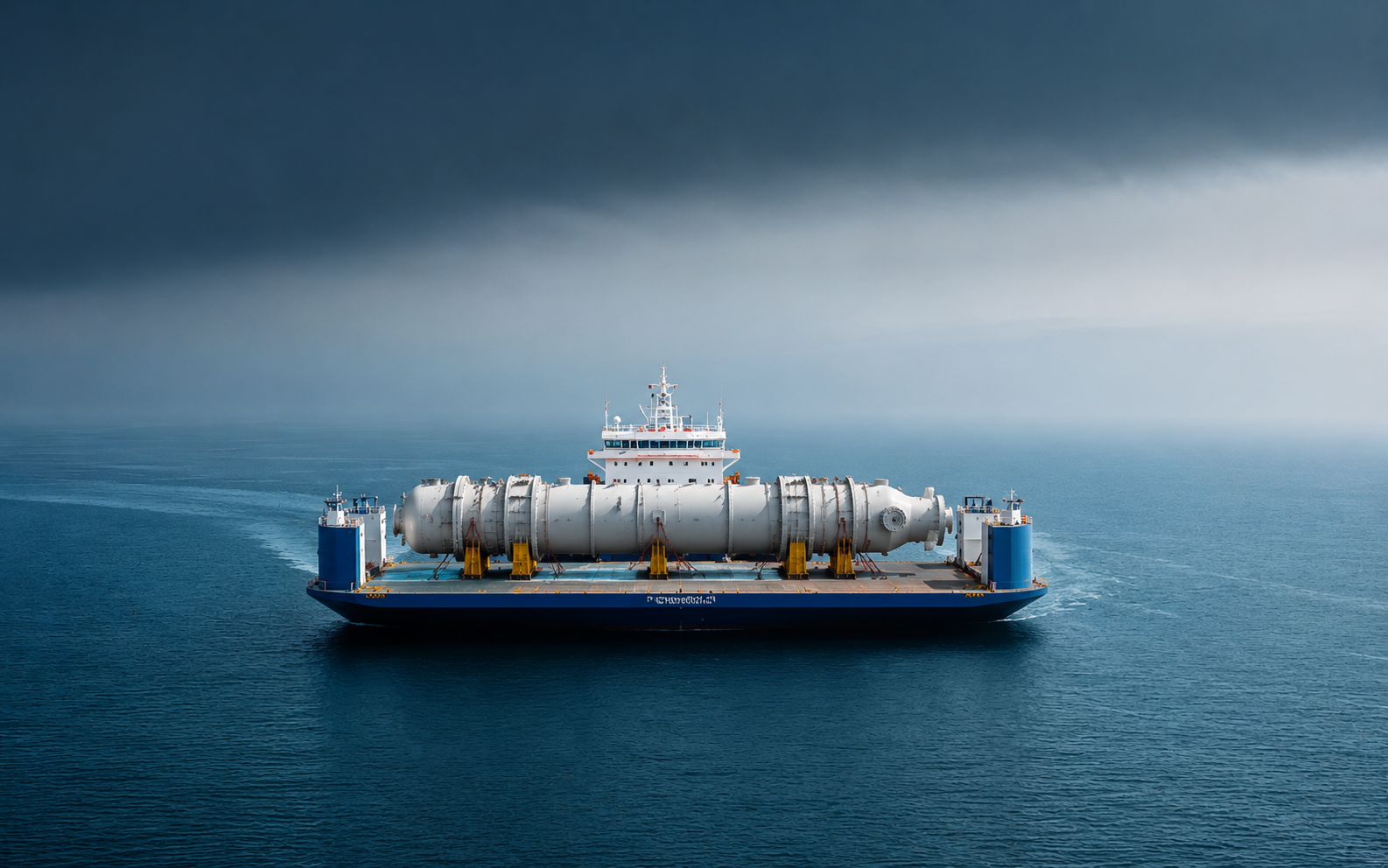
“Where others see tonnage, we see a blueprint. The move is designed before a crate is lifted.”
OOG
Out-of-gauge cargo engineered, not forced into a box
4
Disciplines under one standard of precision
Disciplines
Before a single crate is lifted, our marine engineers calculate stress points, stability curves, and load paths. It's the invisible math that keeps a 200-tonne transformer sitting still in open water.
OOG
Out-of-gauge cargo
ODC
Over-dimensional loads
Tell us about the cargo, the route, and the constraints. We start with engineering, not a booking note.
Trusted across the GCC for OOG and ODC cargo movement.