
Freight forwarding
Coordination without calculation. A booking note is not a load path, and a sailing date is not a stability curve.
Precision engineering for cargo the world cannot move alone. Not freight-forwarding language. A blueprint.
The Problem
Coordination without calculation. A booking note is not a load path, and a sailing date is not a stability curve.
A crane, a crate, a slot — none of them own the physics of the object in open water.
Sourcing, packing, marine, and delivery in different inboxes. The gap between port and paperwork is where project cargo fails.
Tonnage treated as a commodity creates delay, damage, and no one to call when it matters.
Modules and plant that cannot wait on guesswork between vendor, port, and site.
Cargo forced onto the wrong vessel is a class problem, not a stowage convenience.
Heavy, oversized, and fragile in the same move — without a load case.
Delivery that stops at the quay is not delivery. The last mile is still cargo.
The Solution
Chapter 01
Feasibility first. We survey the cargo, the route, the plan, and the site as a single calculation — before anyone talks about a sailing date.
Scroll to dock the next chapter ↓
Chapter 02
Marine engineering and naval architecture define stress, stability, and how the object meets the ship. The blueprint is the move.
Scroll to dock the next chapter ↓
Chapter 03
Packing is not wrapping. It is structural design — sealed, secured, and stress-tested so heavy, oversized, and fragile can travel together.
Scroll to dock the next chapter ↓
Chapter 04
Sourcing, coordination, and delivery sit with one team. Nothing is lost between the port and the paperwork.
End of the sequence
Our Value
1st
the calculation
0
guesswork
Every engagement starts with marine engineering and naval architecture — not a booking note. Where others see tonnage, we see a blueprint.
OOG
out-of-gauge
ODC
over-dimensional
Transformers, modules, plant, and vessels. If it does not fit a box, it still has to fit a load path, a packing design, and a ship.
4
disciplines
1
standard of precision
Marine engineering, naval architecture, packing, and trading under a single team — so nothing is lost between the port and the paperwork.
We do not replace your port, your ship, or your site team. We give them a calculation they can execute against.
Sourcing, packing, marine, and delivery under a single accountable team — so nothing is lost between the port and the paperwork.
How we work
Heavylift fails when the cargo is treated as a booking. We start with stress points, stability curves, and a packing design that can survive open water — then we execute against that blueprint.
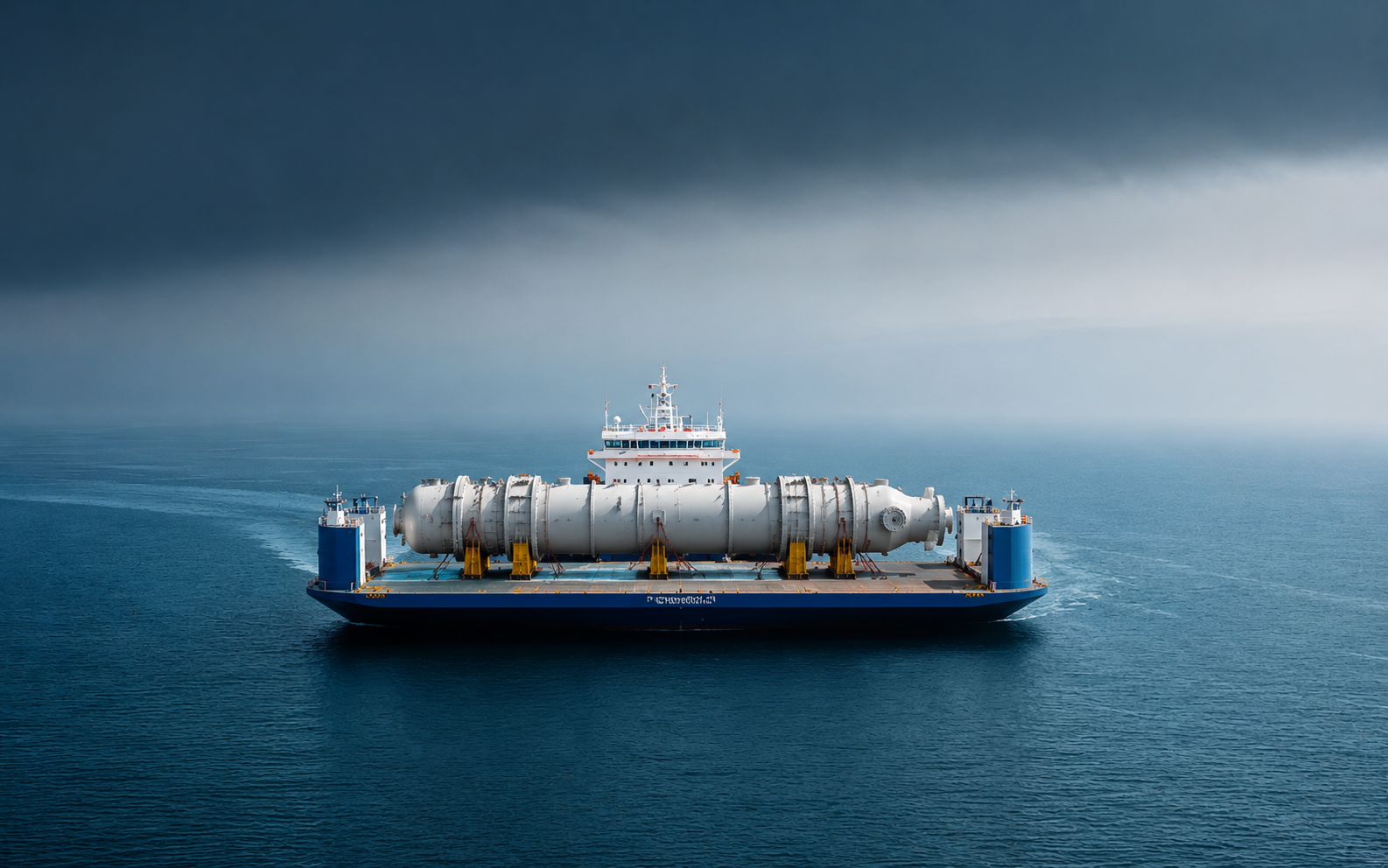
“Where others see tonnage, we see a blueprint. The move is designed before a crate is lifted.”
OOG
Out-of-gauge cargo engineered, not forced into a box
4
Disciplines under one standard of precision
Disciplines
Before a single crate is lifted, our marine engineers calculate stress points, stability curves, and load paths. It's the invisible math that keeps a 200-tonne transformer sitting still in open water.
OOG
Out-of-gauge cargo
ODC
Over-dimensional loads
Tell us about the cargo, the route, and the constraints. We start with engineering, not a booking note.
Trusted across the GCC for OOG and ODC cargo movement.