
Lashing copied from the last job
Accelerations, CG, and deck strength are unique. Template lashing is a failure waiting for weather.
Sea Fastening, Grillage & Lashing
Sea fastening, grillage, and lashing designed to the load case — so complex cargo sits still when the sea does not.
The Problem
Accelerations, CG, and deck strength are unique. Template lashing is a failure waiting for weather.
Grillages are structure. They spread load into the deck and hold the cargo through the voyage.
Weld pads, stoppers, and lash points belong in the plan before the piece lands.
If seakeeping is not an input, the restraint is decoration. We design from the load case.
The Solution
How Sea Fastening, Grillage & Lashing works
Stoppers, weld-downs, and sea-fastening steel sized for the actual accelerations.
Frames that carry the cargo and protect the deck — geometry, welds, and bearing included.
Wire, chain, and webbing laid out against points that exist on both cargo and deck.
One specification from stow to discharge, tied to the transportation plan.
How we work
Heavylift fails when the cargo is treated as a booking. We start with stress points, stability curves, and a packing design that can survive open water — then we execute against that blueprint.
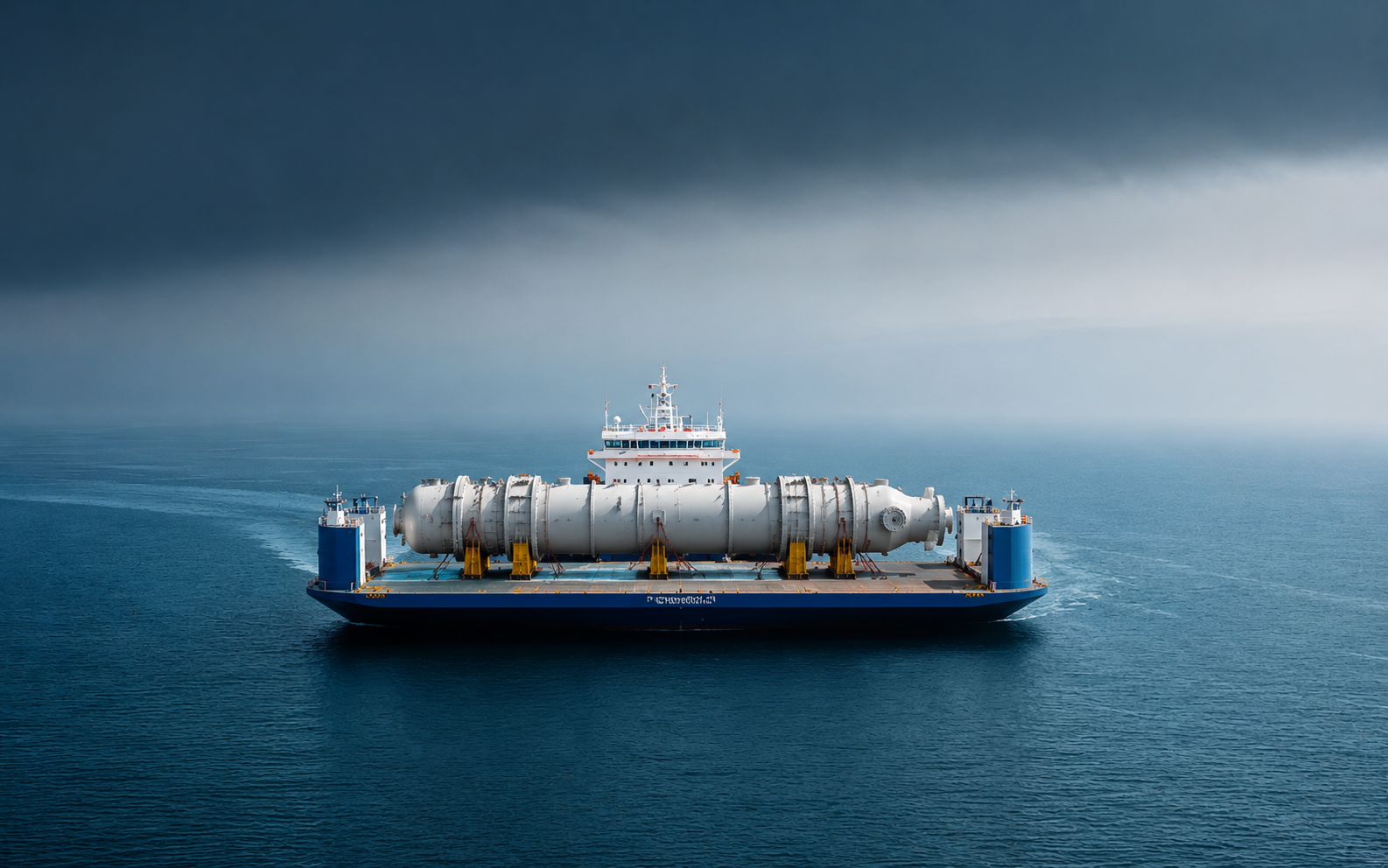
“Where others see tonnage, we see a blueprint. The move is designed before a crate is lifted.”
OOG
Out-of-gauge cargo engineered, not forced into a box
4
Disciplines under one standard of precision
Disciplines
Before a single crate is lifted, our marine engineers calculate stress points, stability curves, and load paths. It's the invisible math that keeps a 200-tonne transformer sitting still in open water.
OOG
Out-of-gauge cargo
ODC
Over-dimensional loads
Tell us about the cargo, the route, and the constraints. We start with engineering, not a booking note.
Trusted across the GCC for OOG and ODC cargo movement.